

ASD Closure — Sealing the “Hole in the Heart” Without Surgery, So Life Can Flow Normally Again
Some hearts are born with a secret passage — a small tunnel between the upper chambers that should have closed before birth.
It’s called an Atrial Septal Defect, or ASD.
And while it may go unnoticed for years — even decades — it’s quietly asking your heart to work harder… and your lungs to bear the burden.
The good news?
Today, closing an ASD doesn’t mean opening the chest.
It doesn’t mean weeks of recovery.
It doesn’t even mean a visible scar.
Thanks to a revolutionary minimally invasive procedure, that hole can be sealed — through a tiny puncture in the leg — often in under an hour. Welcome to the world of ASD Closure — where advanced technology meets compassionate care to give patients back their strength, their stamina, and their future.
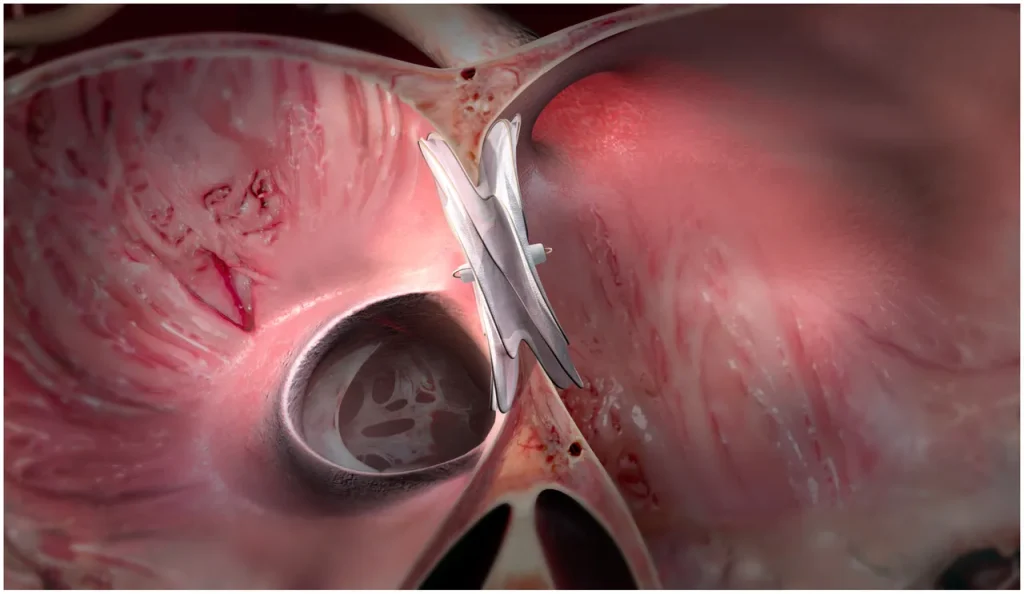
❤️ What Is an ASD?
ASD (Atrial Septal Defect) is a congenital heart defect — meaning it’s present at birth — where there’s an abnormal opening in the wall (septum) between the heart’s two upper chambers: the right and left atria.
This hole allows oxygen-rich blood from the left atrium to leak into the right atrium — then get pumped back to the lungs instead of out to the body. Over time, this causes: → The right side of the heart to enlarge
→ The lungs to become overloaded
→ Shortness of breath, fatigue, or palpitations — often appearing in adulthood
→ Increased risk of stroke, arrhythmias (like atrial fibrillation), or pulmonary hypertension
Many people live with small ASDs without symptoms. But moderate to large defects? They don’t fix themselves — and the longer they’re left open, the more damage they cause.
🧩 Why Close It?
Even if you feel “fine,” an untreated ASD can lead to:
- Heart failure in your 30s, 40s, or 50s
- Irregular heart rhythms (especially AFib)
- Stroke — from blood clots crossing the hole
- Permanent lung damage (pulmonary hypertension)
- Reduced exercise capacity and quality of life
Closing it — even in adulthood — can reverse symptoms, prevent complications, and add decades of healthy living.
🩺 How Is ASD Closed? (The Magic of the Catheter)
In most cases, ASD Closure is performed using a catheter-based, non-surgical technique — no heart-lung machine, no sternotomy, no ICU stay.
➤ Step-by-Step: What Happens During the Procedure
- Access — A thin catheter is inserted into a vein in your groin.
- Navigation — Guided by live X-ray and echocardiography (often TEE), the catheter is threaded up to the heart and across the ASD.
- Measurement — A special balloon may be used to measure the exact size of the hole.
- Deployment — A folded closure device (often shaped like two connected discs) is pushed through the catheter and positioned across the ASD.
- Release — Once perfectly seated, the device is released — sealing the hole from both sides.
- Recovery — The catheter is removed. No stitches. Most patients go home the next morning.
⏱️ Procedure time: 45–90 minutes
🛌 Hospital stay: Usually 1 night
👟 Recovery: Back to school or desk work in 2–3 days; full activity in 1–2 weeks
🆚 ASD Closure vs. Open-Heart Surgery
Invasiveness | Minimally invasive — groin puncture | Open-heart — sternum split |
Scarring | None | Chest scar |
Hospital Stay | 1 night | 4–7 days |
Recovery Time | Days to weeks | 6–12 weeks |
Risk | Very low (device embolization, residual leak) | Higher (infection, bleeding, longer anesthesia) |
Best For | Secundum ASDs < 35–40mm, suitable rims | Large ASDs, unusual anatomy, multiple defects |
👉 Bottom line: If anatomy is favorable — catheter closure is the preferred method. It’s safer, faster, and kinder to patients of all ages.
👶 Who Can Get It?
ASD closure is appropriate for:
- Children (usually age 2+, once defect is confirmed and symptoms or enlargement appear)
- Teens and adults — yes, even at 40, 50, or 60! It’s never “too late” if the lungs and heart are still responsive
- Patients with symptoms (fatigue, shortness of breath, palpitations) or heart enlargement on echo
- Patients with history of stroke or paradoxical embolism
Your cardiologist will use echocardiography (and sometimes CT or MRI) to determine if you’re a candidate.
🚫 Risks? Extremely Low — But Good to Know
While ASD closure is very safe, potential (rare) complications include:
- Device dislodgement (almost always caught and retrieved during procedure)
- Residual shunt (small leak — often closes on its own over months)
- Arrhythmias (temporary — especially in adults)
- Pericardial effusion (very rare)
💡 Pro Tip: Choose a center with high-volume experience in congenital interventions. Success rates exceed 98% in expert hands.
🧑⚕️ What Happens After?
- You’ll have a follow-up echo at 1 month, 6 months, and 1 year to ensure the device is secure and the hole is fully sealed.
- You’ll take aspirin or blood thinners for 3–6 months to prevent clots on the device.
- No long-term restrictions — you can run, swim, travel, and even get pregnant (with monitoring).
- Most patients say: → “I didn’t realize how tired I was until I wasn’t.”
→ “My heart doesn’t race anymore.”
→ “I finally feel normal.”
💬 Real Patient Insight
“I was 42, always thought I was just ‘out of shape.’ Then an echo found a 22mm hole in my heart. I had the closure on a Thursday, went back to work Monday. Three months later, I ran my first 5K. That little device didn’t just close a hole — it opened a whole new chapter of my life.”
— Amir, Tehran
✅ Final Thought
ASD closure isn’t just a medical procedure — it’s a liberation.
It’s freedom from fatigue.
It’s protection from stroke.
It’s permission to live fully — without limits.
Whether you’re a child with a murmur or an adult who’s “always been tired” — that hole in your heart doesn’t have to define you.
Ask your cardiologist:
“Is catheter-based ASD closure right for me?”
The answer might just be the key to unlocking the energetic, vibrant life you were meant to live.