

What Is an Electrocardiogram (ECG/EKG)? Your Simple, Stress-Free Guide to Understanding Your Heart’s Electrical Activity
Whether your doctor ordered an ECG, you’re experiencing heart flutters, or you just saw one on a medical drama — you’re in the right place. Let’s break down what an ECG really is, why it matters, and what to expect — no medical degree required.
❤️ What Is an Electrocardiogram (ECG or EKG)?
An electrocardiogram — often shortened to ECG or EKG (from the German Elektrokardiogramm) — is a quick, painless, non-invasive test that records the electrical activity of your heart.
Think of it as your heart’s “electrical selfie.” It shows how fast your heart is beating, whether the rhythm is steady or irregular, and how strong the electrical signals are as they travel through each part of your heart.
It’s one of the most common, oldest, and most valuable tools in cardiology — and it hasn’t been replaced because… it just works.
📊 Why Would You Need an ECG?
Your doctor might order an ECG if you have:
- Chest pain or pressure
- Palpitations (feeling like your heart is racing, skipping, or fluttering)
- Shortness of breath
- Dizziness or fainting spells
- High blood pressure or known heart disease
- Before surgery or as part of a routine physical (especially if you’re over 40 or have risk factors)
- Family history of sudden cardiac death or arrhythmias
It’s also used to: ✔️ Diagnose heart attacks (past or present)
✔️ Detect abnormal heart rhythms (like atrial fibrillation)
✔️ Check the health of your heart’s chambers and walls
✔️ Monitor the effects of heart medications or devices (like pacemakers)
✔️ Screen athletes for hidden heart conditions
🧪 How Does It Work?
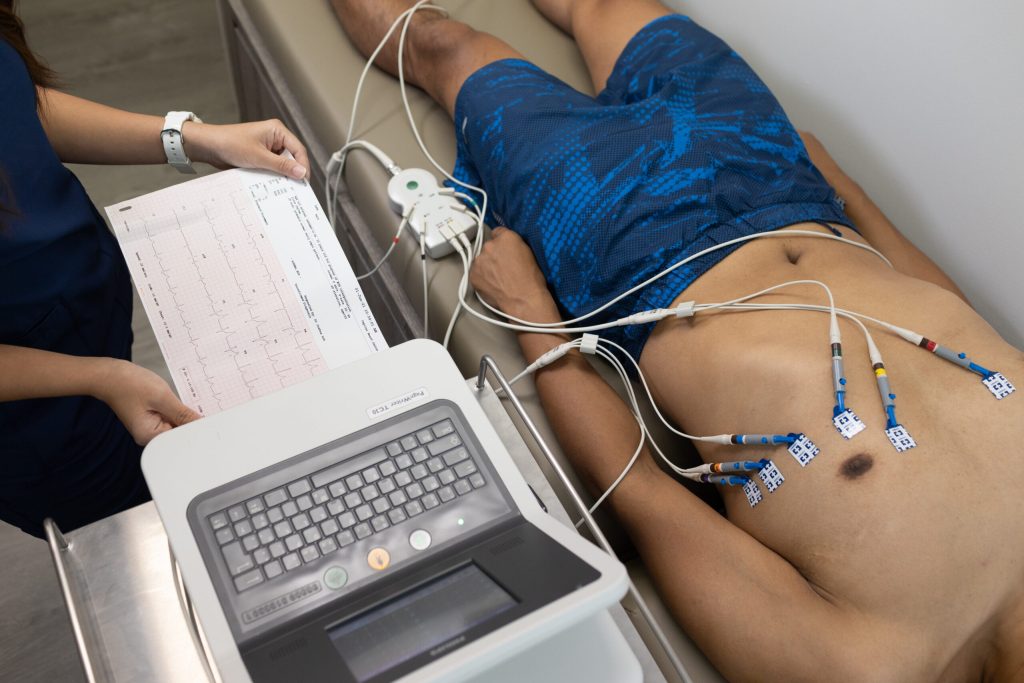
Your heart beats because of tiny electrical impulses that travel through it in a specific pattern. The ECG machine detects these impulses through small sticky patches called electrodes, placed on your:
- Chest (usually 6)
- Arms (1 each)
- Legs (1 each)
These electrodes are connected by wires to the ECG machine, which translates your heart’s electrical signals into waves and lines on a graph — your actual ECG tracing.
⏱️ The test takes 5–10 minutes. You just lie still, breathe normally, and relax. No needles. No radiation. No recovery time.
📈 What Does an ECG Show?
Doctors look at the pattern of waves to assess:
🔹 Heart Rate — Too fast (tachycardia)? Too slow (bradycardia)?
🔹 Rhythm — Regular or irregular (arrhythmia)?
🔹 Conduction — Are electrical signals moving normally through the heart?
🔹 Chamber Size — Signs of thickened heart muscle or strain?
🔹 Blood Flow — Evidence of a current or past heart attack?
🔹 Electrolyte Imbalances — Abnormal potassium or calcium levels can change the ECG
Fun fact: Every ECG has a unique pattern — kind of like a fingerprint for your heart’s electricity.
🆚 ECG vs. What You See on TV
⚠️ Myth: “They shocked the patient — look, the line went flat, then jumped back!”
✅ Reality: A flat line (asystole) means NO electrical activity — shocking won’t help. TV gets it wrong a lot!
⚠️ Myth: “If the ECG is normal, your heart is fine.”
✅ Reality: Some heart problems — like intermittent arrhythmias or early blockages — don’t always show up on a single ECG. You might need a Holter monitor or stress test for more info.
🧬 Types of ECGs
Not all ECGs are created equal. Here’s what you might encounter:
- Resting ECG — The standard one described above. Done while you’re lying still.
- Stress ECG (Exercise ECG) — Done while you walk on a treadmill. Shows how your heart responds to exertion.
- Holter Monitor — Portable ECG you wear for 24–48 hours to catch intermittent symptoms.
- Event Monitor — Worn for weeks; you press a button when you feel symptoms.
- Implantable Loop Recorder — Tiny device placed under the skin for long-term monitoring (up to 3 years).
🚫 Risks? None. Seriously.
There are no risks with a standard ECG. It doesn’t send electricity into your body — it only records what’s already there. Some people get slight skin irritation from the electrode patches, but that’s it.
It’s safe for: ✅ Pregnant women
✅ Children
✅ Elderly patients
✅ People with pacemakers or defibrillators
🧑⚕️ What Happens After the Test?
- Your ECG is reviewed by a doctor — often a cardiologist.
- Results are usually available the same day or within 24–48 hours.
- If it’s abnormal, your doctor will explain what it means and what to do next — which could be nothing, or further testing, or starting treatment.
- If it’s normal but you still have symptoms, don’t be discouraged — your doctor may recommend longer-term monitoring.
💬 Real Patient Story
“I thought my fluttering heart was just anxiety. My doctor did a 5-minute ECG and found I was in atrial fibrillation. One medication later — and no more scary palpitations. That little test changed everything.”
— Maria, 54
✅ Final Thought
An ECG is one of the simplest, safest, and smartest ways to peek inside your heart’s electrical system. It’s not science fiction — it’s science fact, and it saves lives every single day.
If your doctor recommends one — say yes. It might be the most important 5 minutes of your health journey.